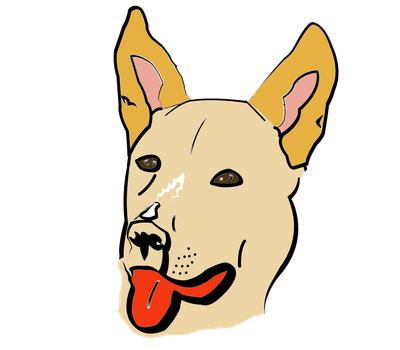
 Carolina Dingo
The American Dingo: An Ancient Story
Long before there were breed clubs, dog shows, or pedigrees, there were dogs living wild in the bottomland swamps and longleaf pine forests of the American Southeast. Rural southerners knew them for generations as “yaller dogs” — lean, ginger-colored, sharp-eared dogs that kept to themselves at the edges of settlements.

A Scientist Notices Something Wild
The breed's modern story begins in the 1970s, when Dr. I. Lehr Brisbin Jr., a senior ecologist at the University of Georgia's Savannah River Ecology Laboratory, began noticing free-ranging dogs on the isolated federal land of the Savannah River Site in South Carolina. What struck him was how much these dogs looked like dingoes and other ancient pariah dogs from the other side of the world: the same ginger coat, wedge-shaped head, almond eyes, upright ears, and distinctive curved “fish-hook” tail.
Brisbin began studying, and eventually breeding and registering, these dogs under the name Carolina Dog. His hypothesis was bold: these weren't simply strays gone feral, but possibly descendants of the primitive dogs that accompanied the first peoples across the Bering land bridge thousands of years ago — a living remnant of America's original dogs.
What the Science Says
The full picture is still being written. Some genetic studies of free-ranging Carolina Dogs have found traces of ancient, pre-European ancestry alongside more recent European breed ancestry, while other research emphasizes how much mixing has occurred over the centuries. What no one disputes is what these dogs are: a naturally evolved landrace, shaped by survival in a harsh environment rather than by human selection for looks — and that alone makes them extraordinary among modern breeds.
From the Swamps to Recognition
Carolina Dogs are today recognized by the United Kennel Club (UKC), which classifies them among the pariah and sighthound types, and the breed has been recorded in the American Kennel Club's Foundation Stock Service as a step toward possible full AKC recognition. They remain rare: most Americans have never knowingly seen one — though plenty of southern shelter dogs carry unmistakable Carolina Dog looks.
Free-ranging populations still exist in pockets of the rural Southeast, though habitat loss and interbreeding make truly wild Carolina Dogs harder to find every year. That's part of why enthusiasts care so much about the breed: it is a living piece of American natural history.
Living History, Sleeping on the Couch
When our own Carolina Dog, Panda, curls into a tight ball with her tail over her nose, or freezes at a sound in the yard nobody else heard, we're watching behaviors that kept her ancestors alive in the wild for centuries. That's the quiet magic of this breed — ancient instincts, wrapped in a dog who also insists on the good end of the couch.

Next: the traits and temperament that make Carolina Dogs unique →